If you’re planning to buy a Laser Welding Machine in 2026, you’re probably asking the same question most buyers do: “What’s the real Laser Welding Machine Price—and which model gives me the best value for my money?”
The truth is: price alone doesn’t define value. The best-value Handheld Laser Welding Machine for a fabrication shop may not be the best choice for an OEM line, and vice versa. In this detailed guide, we’ll break down the 2026 pricing factors, model types, and how to compare machines like a pro—so you can confidently choose the right equipment.
Why Laser Welding Demand Is Rising in 2026
In 2026, industries are shifting toward high-precision joining with less rework, faster cycles, and cleaner results. Laser welding fits perfectly because it offers:
- Minimal heat-affected zone (HAZ)
- Reduced distortion on thin materials
- Cleaner weld beads with less finishing
- Higher productivity in repetitive jobs
- Easier automation integration in production environments
Because of these benefits, more buyers are exploring Laser Welding Machine manufacturer companies for production upgrades across:
- Sheet metal fabrication
- Automotive & EV components
- Stainless steel products
- Kitchen equipment and architectural fabrication
- Electronics enclosures and precision assemblies
Laser Welding Machine Price in 2026: What to Expect
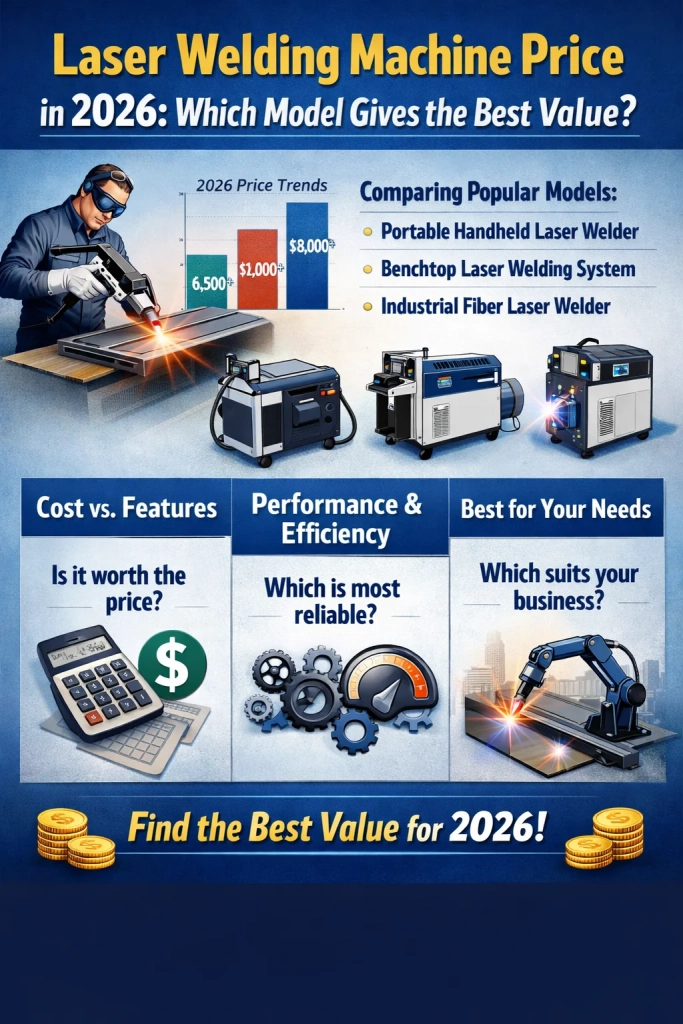
The Laser Welding Machine Price in 2026 depends mainly on machine type (handheld vs automation), laser source power, cooling type, welding head quality, and after-sales support. Prices also vary by region and supplier network.
Typical price ranges (industry-wide estimates)
While actual pricing varies by brand and configuration, most buyers will see ranges like:
- Handheld Laser Welding Machine: entry to mid-range investment (widely used for general fabrication)
- Automated / Robotic laser welding systems: higher investment (best for high-volume production)
- Micro / precision laser welding machines: specialized pricing (jewelry, medical, electronics)
Instead of focusing on a single number, treat price as a package: performance + uptime + support + consumables + warranty + safety.
What Drives Laser Welding Machine Price?
Let’s break down the key price drivers that matter most when comparing options from different Laser Welding Machine manufacturer companies.
1) Laser Power (Wattage) and Material Capability
Power directly impacts:
- penetration depth
- welding speed
- suitable thickness range
Higher power usually means higher cost, but also higher throughput – especially for stainless steel, mild steel, and aluminum applications.
Best value tip: Choose power based on your real thickness requirements, not just “future possibilities.” Oversizing increases cost and energy consumption.
2) Laser Source Brand and Efficiency
Most modern systems use fiber laser sources. Source quality affects:
- beam stability
- lifetime and maintenance
- energy efficiency
- consistent output across shifts
If two machines have the same power rating but different source quality, the cheaper one can become expensive later due to downtime and inconsistent weld quality.
Best value tip: Ask about source warranty, mean-time-between-failure, and service availability.
3) Cooling System: Air-Cooled vs Water-Cooled
- Air-cooled handheld units are typically lighter, simpler, and easier for smaller workshops.
- Water-cooled systems handle long duty cycles better and are common in heavy production.
Cooling affects:
- continuous runtime
- stability during extended use
- maintenance pattern
Best value tip: If your welding happens in long shifts, water cooling often gives better reliability—despite higher initial cost.
4) Welding Head Quality and Ergonomics
In a Handheld Laser Welding Machine, the welding gun matters a lot:
- operator comfort
- stability of bead shape
- ease of maintenance
- safety interlocks
The price increases with better optics, stable focusing systems, and durable protective window design.
Best value tip: Don’t judge handheld models only by wattage—judge by gun design and operator experience.
5) Safety Package and Compliance
Laser welding requires safety measures:
- laser safety eyewear and controlled area
- interlocks and emergency stops
- fume extraction compatibility
- training and documentation
Some sellers quote a low machine price but exclude the complete safety kit.
Best value tip: Compare “ready-to-run” cost, not just the base machine.
6) Support, Spares, and Service Network
A reliable Laser Welding Machine manufacturer will provide:
- installation and commissioning
- operator training
- local service engineers or partner network
- genuine spares and fast delivery
This is where value becomes real. A cheaper machine with slow service can stop production and cost far more than you saved.
Best value tip: Ask for response time SLA, spare availability, and service coverage in your city.
Laser Welding Machine Models in 2026: Which Gives Best Value?
Here are the most common model types and where each provides the best value.
1) Handheld Laser Welding Machine (Most Popular Value Choice)
Who should buy it?
- Job shops and general fabricators
- Stainless steel railing/kitchen equipment manufacturers
- Sheet metal contractors
- SMEs upgrading from TIG/MIG for better finish
Why it’s high value in 2026
A Handheld Laser Welding Machine often gives the best value because it:
- reduces post-weld grinding and polishing
- speeds up common fabrication tasks
- enables cleaner joints with less warping
- is easier to train operators on than advanced automation
When it’s not the best option
If you produce large volumes of repetitive parts, handheld welding may not match the productivity of automation.
Best value verdict:
For most workshops, handheld models usually deliver the best “ROI per rupee” because they improve both output and finish quality quickly.
2) Automated / Robotic Laser Welding Systems (Best for High Volume)
Who should buy it?
- OEM production lines
- Automotive/EV component manufacturers
- High-volume enclosure and cabinet manufacturing
- Companies with consistent part geometry and fixtures
Why it offers value
Automation value comes from:
- consistent weld quality
- higher throughput
- reduced dependence on operator skill variation
- data tracking and integration (Industry 4.0 readiness)
What increases price here?
- robot + safety enclosure
- fixtures and jigs
- seam tracking, vision, sensors
- PLC integration and production validation
Best value verdict:
If your work is repeatable and high volume, automated systems can be the best long-term value—even with higher upfront cost.
3) Precision / Micro Laser Welding Machines (Specialized Value)
Who should buy it?
- medical device manufacturers
- electronics and sensors
- jewelry and fine parts production
- thin-wall or micro assemblies
These machines are value-driven not by speed, but by:
- ultra-precise energy control
- minimal thermal damage
- high repeatability
Best value verdict:
For precision industries, micro laser welding is often the only process that meets quality standards—making it “best value” even at a premium.
How to Choose the Best-Value Model (A Practical Checklist)
Instead of asking “Which one is cheapest?”, ask these value questions:
A) What is your real material mix?
- SS 304/316?
- mild steel?
- aluminum (more challenging due to reflectivity and heat behavior)?
- galvanized sheets?
Value changes based on your material needs and joint types.
B) What thickness do you weld daily?
If most jobs are thin to medium range, you don’t need an oversized system.
C) How many hours per day will you weld?
- Light use: compact models can be value winners
- Heavy use: robust cooling and source stability matters more
D) Do you need welding only—or multi-function?
Some handheld systems are sold as weld + clean + cut packages. If you’ll use cleaning regularly (rust removal, pre-weld cleaning), that can increase value.
E) What’s your finishing cost today?
If you spend heavily on grinding and polishing after TIG/MIG, laser welding can pay back faster due to cleaner results.
Best Value by Buyer Type (Quick Recommendations)
Small fabrication shops (cost-sensitive + fast ROI)
Best value: Handheld Laser Welding Machine
Why: fast setup, versatile, strong productivity jump
Medium manufacturers (repeatable parts + higher output goals)
Best value: Handheld + basic fixtures OR semi-automation
Why: balance cost and consistency
Large OEMs (high volume + strict standards)
Best value: Automated / robotic laser welding line
Why: stable output, traceability, throughput
Precision industries (tiny parts + zero-defect needs)
Best value: Precision / micro laser welding machine
Why: only solution that meets quality requirements reliably
How to Evaluate Laser Welding Machine Manufacturer Companies
Not all Laser Welding Machine manufacturer companies offer the same quality and service. Before finalizing any Laser Welding Machine Price, evaluate:
- Company credibility and installed base
- Warranty terms (source, head, electronics)
- Local service presence and spare availability
- Application testing and sample weld reports
- Training and safety guidance
- Real customer reviews or case studies
A trusted Laser Welding Machine manufacturer typically supports you beyond the sale—this support is often the difference between “machine bought” and “machine producing.”
Hidden Costs to Include in Laser Welding Machine Price
When you compare quotes, include:
- safety kit and eyewear
- fume extractor compatibility
- protective lenses/windows (consumables)
- service contract after warranty
- training time and setup
- electrical requirements and stabilizer/UPS if needed
Best value tip: Request a “total cost of ownership” view for 12–24 months, not just the invoice price.
Final Answer: Which Model Gives the Best Value in 2026?
In 2026, the best value depends on your production reality:
- If you run a fabrication shop and need versatility and fast ROI:
Handheld Laser Welding Machine is usually the best value. - If you’re a high-volume manufacturer with repeatable joints:
Automated laser welding gives the best long-term value. - If your work is micro-precision and quality-critical:
Precision laser welding is the best value because it prevents rejection and rework.
If you choose based on workload, material thickness, duty cycle, and support quality—not just price—you’ll get the best return from your Laser Welding Machine investment.